

Pluto Stations Retrograde: Why Should You Care?
Why this generational planet is actually quite personal

Hi everyone!
Astrology You Should Know About
Pluto stations retrograde on May 6th and it seems appropriate to spend some time telling you why you should (or shouldn’t) care.
For a beginner to astrology, or someone with a more casual interest in it, it’s easy to feel like the astrological daily news can get pretty noisy. Every day there’s at least something “new” to talk about, whether a planet changing signs, an aspect, a retrograde, a brief rest-stop in the lunar cycle.
All of these things, in the appropriate context, can be tremendously important. But it can also be like having some super-eager assistant busting into your office to tell you every time the minute hand on a clock moves.
“That’s great, man, thank you! That would be really helpful if I had an appointment for 4:30, but I don’t today, nor do I have one at 4:31, 4:32, or really all day, so why don’t you find something to do.”
Okay, not a 100% perfect metaphor, but you get the point.
Now, with Pluto? Pluto isn’t the minute hand, it’s not the hour hand, and it’s not even the dang month or year hand, if your clock even had those.
Pluto is like a crack in the earth 100 meters below both the clock and the whole damn office building, slowly growing. I mean, it takes Pluto 248 years to complete its full orbit.
Now, in astrology, planetary retrogrades are described as periods where the energies and significations associated with the planet are turned inward. And this makes intuitive sense with the more personal planetary retrogrades of Mercury, Venus, or Mars. Generally speaking, that also resonates with how people often experience those transits.
But, as a slow-moving, transpersonal planet, isn’t Pluto always kind of internal? Like, what the heck do we make of Pluto retrograde? What does that feel like?
Honestly, you might not “feel” anything.
Some astrologers might even argue that on a personal level, retrograde or not, unless transit Pluto is aspecting something in your chart, it’s not meaningful, it’s not doing anything, and it’s not active. Pluto and the other transpersonal planets (Neptune and Uranus) are generational, and it’s sometimes said that you can’t really associate personal significations with them unless they’re activating a planet or angle in your natal chart.
But I don’t think that’s the right way to think about it either.
Yes, Pluto’s sign in our natal chart marks our generation, but it also rules our deep subconscious relationship to having been born into that generational moment—how we learned and internalized its subtle dynamics of power, control, hate, evil, desire, and transformation from the people, things, institutions, and other artifacts that were embedded in it.
It’s not just that we’re born into our unique generational moment in some abstract way. It’s incredibly personal.
The themes of our Pluto generation are disseminated (and implanted in us) by our parents, our teachers, principals, neighbors, etc., who all served particular roles that were in part defined by that moment.
All of that goes somewhere deep within us, in ways that are unique from everyone else. Often the house position of our natal Pluto (given that this will depend on our exact time of birth) can reveal a lot about our personal inheritance of the generational. And this is the area of our life experience where we—in ways both within and wholly outside our control—will slowly unravel those psychic artifacts we’ve been burying since we were children. (Aspects are important and highly personal too, of course.)
And so even when we’re talking about how a transiting Pluto might affect a person’s chart, it’s that natal Pluto that is ultimately always at the center of the story.

That natal Pluto is like a marker on the psychic map, pointing to some place where some A&E True Crime story went down. Some deep, dark mystery. Where the shadow of a generation seemed to touch us in a highly personal way. Maybe something was taken against our will, something that ravaged us that we were powerless to control.
And maybe not even literally.
Wait, what? I appreciate this is a strange point, but lots of things in astrology are strange. Sometimes there was some specific thing, and sometimes our Pluto is just a representation of what we subjectively experienced or remembered in deeply sensitive or powerful way. Like a personal myth—whether the “crime” happened the way we thought it did (or whether it happened at all) might be irrelevant compared to the deep psychic themes we get pulled in to confront nevertheless.
As Pluto transits out of its natal house and into other houses, we will often experience that lifelong theme in a different part of our life—a different part of the canvas.
For example, someone with natal Pluto in the 4th, whose Pluto is transiting their 7th, might find familial challenges, power dynamics with parents, intense relationships with a parent, etc., triggered or recreated in marriage or partnership. Or someone with natal Pluto in the 6th, who might have some pain around integrating stability and the power to self-architect their life, might find those fears re-triggered during an 8th house Pluto transit, when routines are shaken by major life phase endings or a loss of control that comes with significant co-investments.
The rub is that there are years and years of jagged, mostly internal, mostly unconscious “noise” that’s some parts emotional, some psychosomatic, some physical, some intelligible, moving at a barely noticeable pace between the meaningful landmarks we’re ever going to be able to properly identify and say, “hey, that’s Pluto stuff!”
In other words, don’t forget that Pluto can spend 11 to 32 years in a sign. Pluto lessons reveal themselves across huge spans of time where we’re just being jaggedly present with our inner worlds, with our souls. The wisdom here can’t be forced.
But hey! It’s worth it to try and tap in once in a while, to be mindful of what’s buried deep below. And, the “big” plutonic moments in life (where the inner tends to manifest in the external as identifiable life experiences) are usually marked by aspects to natal chart points. But they don’t come from nowhere—they’re merely the volcanic eruptions of an inner lava that started bubbling long, long before.
Which brings me (finally) back to Pluto retrograde.
Think about it as the lava getting stirred a little differently. Unfortunately (or maybe fortunately), for the person completely cut off from their psychic depths, stirring differently doesn’t mean much.
But for the inward-looking person—or especially for the person experiencing Pluto in an angular house (especially close to an angle), or Pluto in aspect or near aspect to another chart point or planet—that slight movement might agitate something. That’s why therapy, inner work, “depth” stuff, letting go of things, processing grief, acknowledging invisible or ignored truths—all of these are generally favored during a Pluto retrograde.
Tomorrow: Part 2, where we get specific about this Pluto retrograde in Aquarius and what this particular moment is stirring up.
Awful
Pluto was demoted from a planet to a “dwarf planet” in 2006.
Is it actually awful? I don’t know, I’m being a little silly, but probably not. Whether Pluto is a “planet” or not is largely trivial for its astrological significations.

That said, as additional dwarf planets and other objects have been discovered in the 2000s, it raises legitimate questions about how these are incorporated into modern astrology. Significations of other planets and bodies are the product of thousands of years of recorded observations. How do we think about something like Makemake, a dwarf planet discovered in 2005? This isn’t really awful—I think it’s mostly exciting. Modern planetary discovery will inevitably raise questions, though, that are incumbent on modern astrologers to take on.
Good
NASA’s chief is trying to officially make Pluto a planet again!

While this back-and-forth between “it should never be a planet again” vs. “let’s make it a planet again” always seems to be somewhere in the news when I look, I find it interesting that there’s been another flurry of new press on it right in the last few days—just as Pluto is stationing.
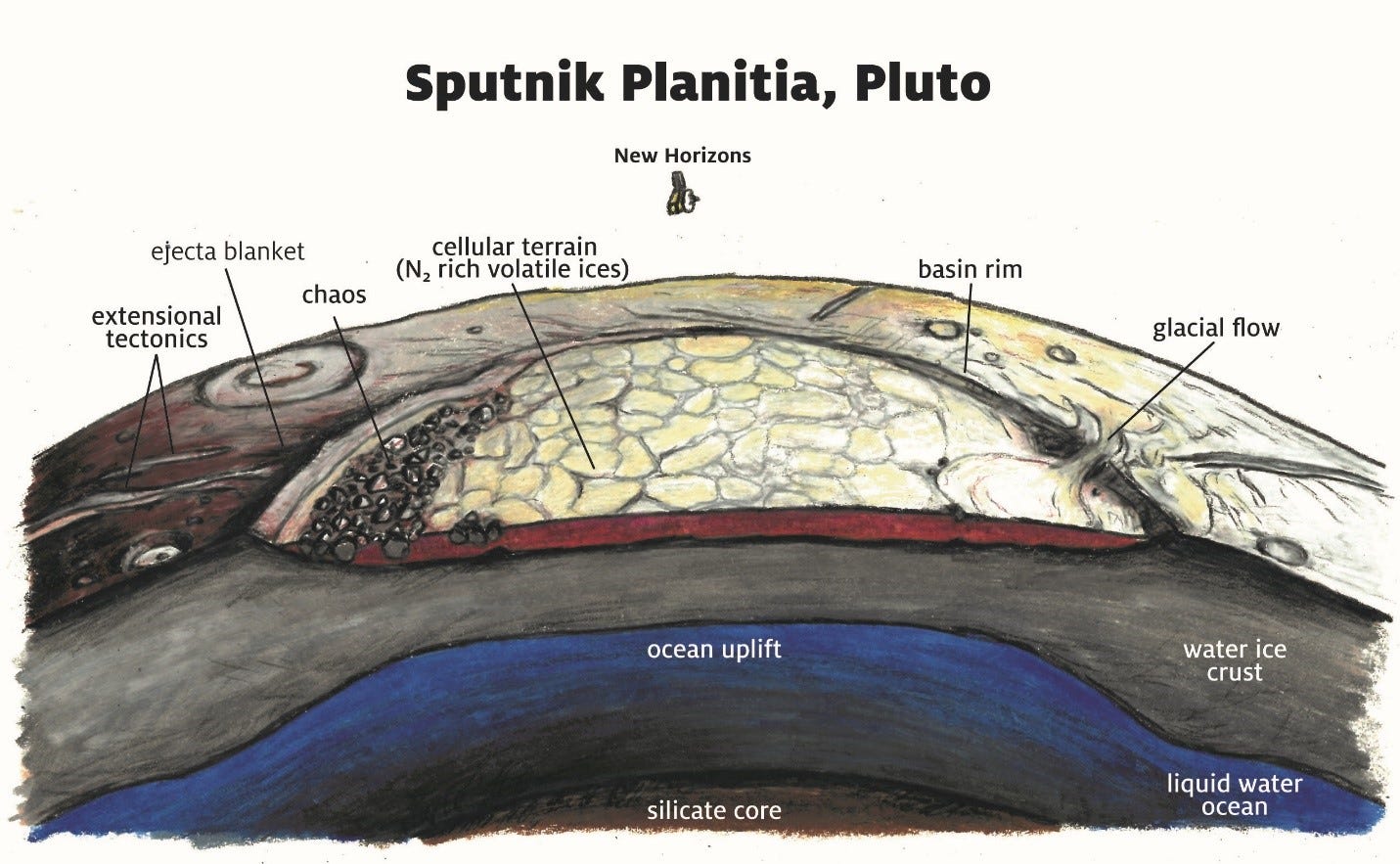
Other facts about Pluto that I find cool from both a scientific/astronomical and a symbolic perspective (all of the facts and images below from this story):
Pluto has a literal beating “heart” that controls its atmosphere and climate.

Pluto was—and still may be—volcanically active.

There’s probably a vast, liquid, water ocean sloshing beneath Pluto’s surface.
I spent more time than I expected on Pluto (never a bad thing), so I’ll leave at that for today.
How do you make sense of your Natal Pluto? Drop a line in the comments.
Talk soon!
Thanks for a solid analysis of how Pluto shows up, without succumbing to the temptation to over-dramatize. Although Pluto does lend itself to dramatics!